Back to homepage

Publications & Preprints

Research in video understanding, object-centric reasoning, and efficient visual learning.

My name is shown in bold. Download all BibTeX · Google Scholar

Preprints

Persistent Object Narratives for Token-Efficient Video Language Models

Junzhe Chen, Siyuan Meng, Xiaojie Guo

arXiv preprint, 2026

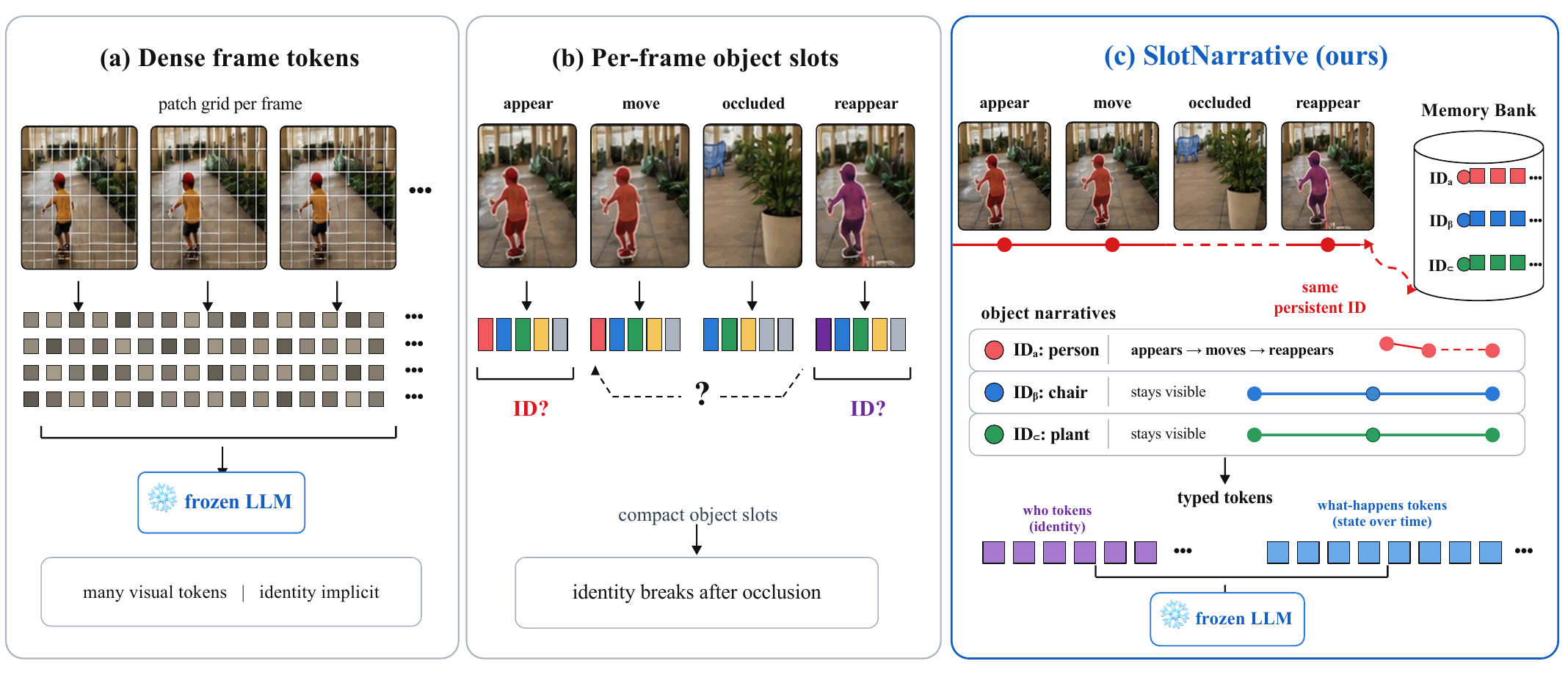
SlotNarrative links recurring object observations through a lightweight, parameter-free memory, then represents each object with identity and state tokens. It provides a compact interface of 144 allocated visual-token positions for a frozen Video-LLM, independent of the number of sampled frames.

Comparison of frame tokens, per-frame object slots, and persistent object narratives in SlotNarrative.
Overview of SlotNarrative: linking observations into persistent object narratives. View full size

TOC-Bench: A Temporal Object Consistency Benchmark for Video Large Language Models

Junzhe Chen, Siyuan Meng, Yuxi Chen, Man Zhao, Wenyao Gui, Xiaojie Guo

arXiv preprint, 2026

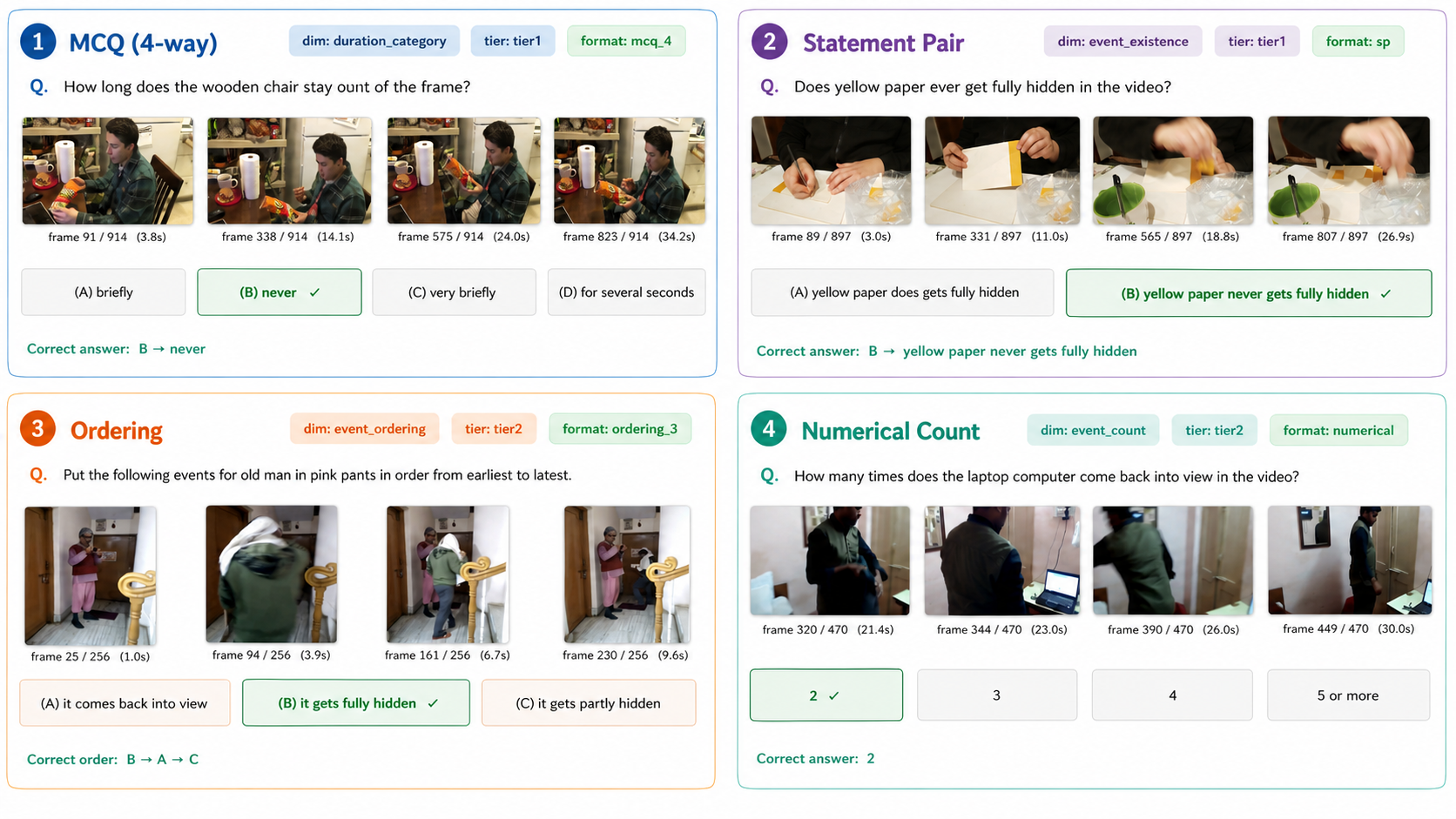
TOC-Bench evaluates whether Video-LLMs preserve object identity, state, and temporal continuity through occlusion, disappearance, reappearance, and interactions. It contains 2,323 human-verified questions over 1,951 videos, covering 10 diagnostic dimensions with object-track-grounded evidence.

Four examples from TOC-Bench illustrating multiple-choice, statement-pair, event-ordering, and counting tasks.
Representative TOC-Bench questions across four task formats. View full size

Peer-reviewed publications

Semi-RSTOD: Toward Semi-Supervised Remote Sensing Tiny Object Detection

Wenhao Xiang, Qianying Tang, Junzhe Chen, Xiang Wei, Shunli Zhang, Li Zhang

Journal of Electronic Imaging, 34(3), 033047, 2025

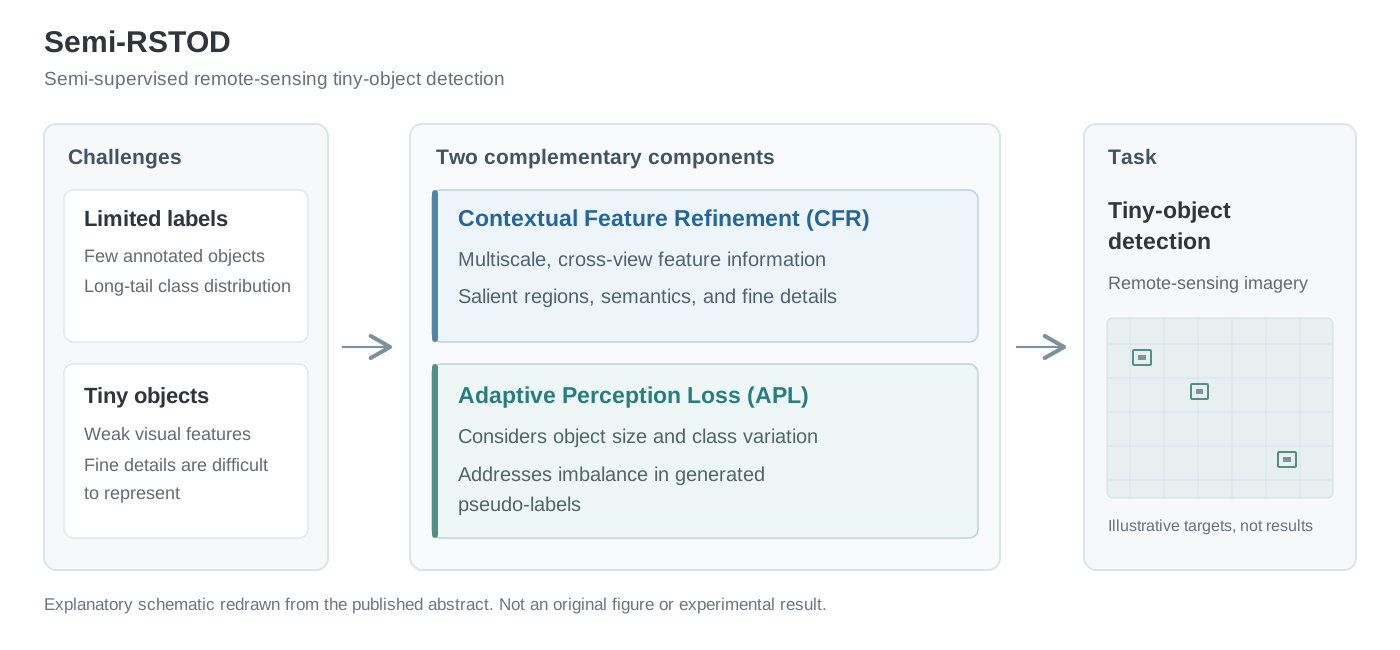
Semi-RSTOD combines contextual feature refinement (CFR) with an adaptive perception loss (APL) for remote-sensing tiny-object detection. CFR uses multiscale cross-view features to preserve salient regions and fine details, while APL accounts for object size and class variation to address imbalance in pseudo-labels.

Semi-RSTOD explanatory schematic: limited labels and tiny-object features motivate contextual feature refinement and adaptive perception loss.
High-level method overview, redrawn from the published abstract; not an original paper figure. View full size

Adaptive Quantization with Mixed-Precision Based on Low-Cost Proxy

Junzhe Chen, Qiao Yang, Senmao Tian, Shunli Zhang

IEEE International Conference on Acoustics, Speech and Signal Processing (ICASSP), pp. 6720–6724, 2024

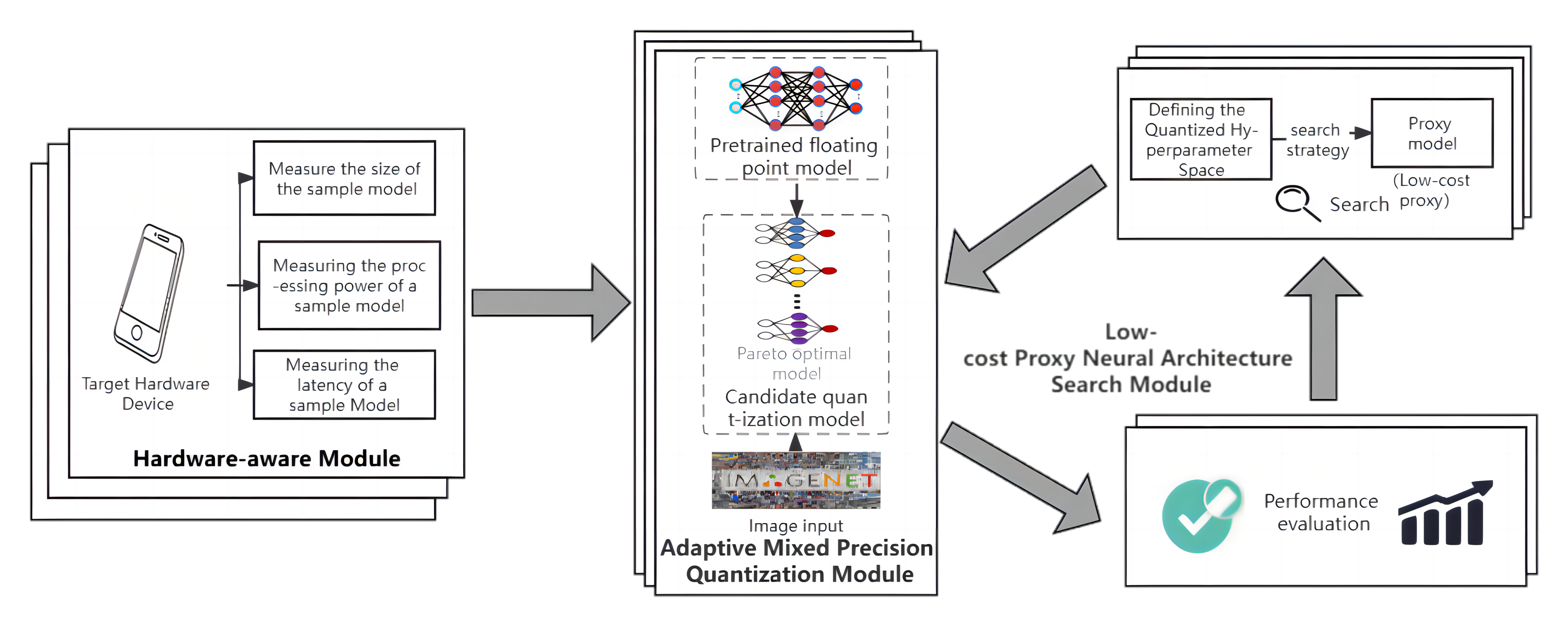
LCPAQ combines hardware-aware profiling, Hessian-based sensitivity analysis, and Pareto selection for mixed-precision quantization. Integer programming and a low-cost proxy search help select layer-wise quantization settings for resource-constrained deployment.
LCPAQ framework showing hardware-aware profiling, mixed-precision quantization, and low-cost proxy search.
The three main modules of the LCPAQ quantization framework. View full size